Binance co-CEO Yi He hit by WeChat hack amid growing Web2 risks for crypto execs

cointelegraphОпубликовано 2025-12-10Обновлено 2025-12-10

Введение

Yi He, the newly appointed co-CEO of Binance, reported that her WeChat account was hijacked after an old mobile number associated with it was reassigned. The attackers used the compromised account to promote a token called Mubarakah, netting approximately $55,000. This incident follows a similar WeChat hack of Tron founder Justin Sun in November. SlowMist founder Yu Xuan explained that attackers can seize accounts by contacting frequent contacts, including those with minimal interaction, and warned that recycled mobile numbers in China create vulnerabilities. He advised high-profile users to avoid adding unknown contacts, rotate passwords, and monitor login alerts. Binance co-founder Changpeng Zhao also confirmed his long-unused WeChat account would not promote any memecoins, urging users to stay vigilant.

Newly appointed Binance co-CEO and co-founder Yi He said on X that her WeChat account was hijacked after an old mobile number was taken, highlighting how Web2 messaging platforms can be used to impersonate crypto executives.

“WeChat was abandoned long ago, and the phone number was seized for use. It cannot be recovered at present,” she said in a translated X post.

Blockchain analytics firm Lookonchain flagged that after the hack, the attackers promoted a token called Mubarakah, pumping the price. The platform claimed that the attackers netted $55,000 with the scheme.

The attack comes days after the Binance co-founder was appointed as the co-CEO of the crypto exchange platform. Binance CEO Richard Teng announced the news at Binance Blockchain Week in Dubai, calling it a “natural progression.”

Source: Yi He

SlowMist founder outlines how to avoid the attack vector

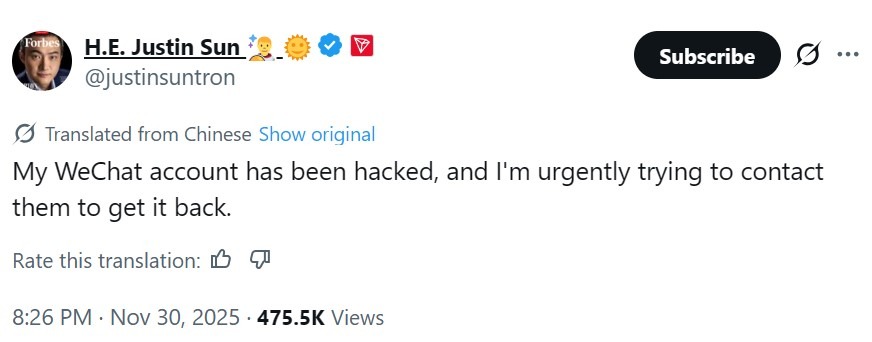
This follows a previous WeChat compromise in November, which involved Tron founder Justin Sun. On Nov. 30, Sun posted on X that his account was hacked and that he had contacted the platform to try to get the account back.
Source: Justin Sun

After the most recent attack, SlowMist founder Yu Xuan re-published a breakdown on how WeChat account takeovers may occur, warning that the barrier to attacks can be surprisingly low.

According to his test, an attacker who already has access to leaked login credentials could seize control of an account by contacting two “frequent contacts.”

He said that this might include people who were never directly messaged and merely added as friends or interacted with briefly in a shared group.

In China, carriers typically reissue mobile numbers to the market three months after users cancel their accounts.

This system, where inactive SIM-linked accounts can be reclaimed or reassigned, creates openings for credential stuffing, SIM-linked recovery abuse and targeted social engineering.

The SlowMist founder urged users, especially high-profile figures who handle over-the-counter (OTC) traders or wallet-related discussions, to avoid adding unknown contacts casually. He also recommended rotating passwords and responding quickly to login alerts.

Related: South Korea to impose bank-level liability on crypto exchanges after Upbit hack: Report

CZ warned that he would not promote memecoin contracts

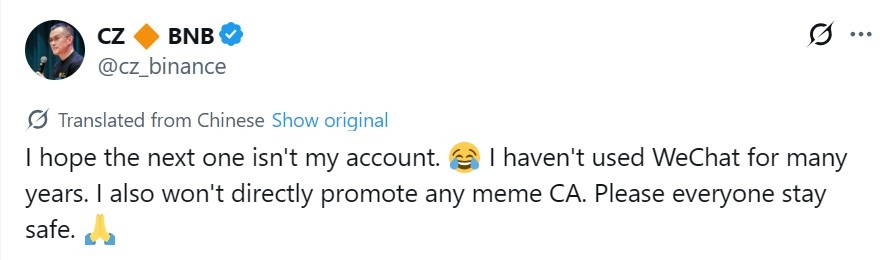
Binance co-founder Changpeng Zhao said on X that he has also not used his WeChat account for a long time.

However, Zhao warned that he would not promote any memecoin contract addresses on this account, giving users a quick reminder to stay safe amid growing threats.
Source: Changpeng Zhao

The incident comes only months after BNB Chain’s official X account was compromised. On Oct. 1, hackers took over and started posting phishing links on the official social media of the blockchain network.

BNB Chain previously told Cointelegraph that 10 links were posted and that $8,000 in user funds were lost. The company said that all affected users have been fully reimbursed.

Magazine: Quantum attacking Bitcoin would be a waste of time: Kevin O’Leary

Похожее

Analyst: Ripple (XRP) Price Could Rise from $2 to $10 in Less Than a Year

Cryptocurrency analyst Chad Steingraber predicts that XRP could surge from $2 to $10 in less than a year, driven by strong institutional demand through recently launched exchange-traded funds (ETFs). Key factors supporting this outlook include the rapid accumulation of XRP by ETFs. Data from SoSoValue shows that XRP-focused ETFs have absorbed over 506 million XRP (worth approximately $506 million) in under a month since their launch in November. This represents about 0.74% of XRP’s circulating supply—a significant level of adoption in a short time. Additionally, the Bitwise Crypto 10 Fund (BITW), which holds XRP as 5% of its portfolio, began trading with over $1.25 billion in assets. Steingraber draws parallels to Bitcoin’s post-ETF performance, suggesting that continued ETF inflows could propel XRP toward a 400% price increase by 2026. Technically, XRP’s chart patterns support a bullish outlook. On weekly charts, the token has broken out of a multi-month symmetrical triangle—a pattern often indicating a strong trend continuation. The measured move from this pattern suggests a potential rise to the $14–$15 range. A second pattern, a bull flag observed on higher timeframes, also points to a target near $14–$15, reinforcing the analyst’s prediction. The article includes standard disclaimers that it is not investment advice and all trading carries risk.

cointelegraph_中文2 мин. назад

Analyst: Ripple (XRP) Price Could Rise from $2 to $10 in Less Than a Year

cointelegraph_中文2 мин. назад

Bitcoin (BTC) Year-End Push to $100,000 Largely Depends on Fed Policy Pivot Outcome

Bitcoin's potential to reach $100,000 by year-end is heavily dependent on the outcome of the U.S. Federal Reserve's policy shift. The recent 4% drop in Bitcoin, bringing it to a low of $88,140, highlights the market's sensitivity to monetary policy and credit risk. A key factor is the Fed's transition away from quantitative tightening, which concluded on December 1. Over the past six months, this policy has removed $1.36 trillion in liquidity from the financial system. The market is now pricing in a high probability of rate cuts, with expectations for three reductions by September 2026. Lower interest rates and increased systemic liquidity reduce the appeal of fixed-income assets, as seen with money market funds hitting a record $8 trillion. Simultaneously, rising credit risk in the tech sector, exemplified by Oracle's soaring debt protection costs, is pushing investors toward scarce assets like Bitcoin. Oracle, with $105 billion in debt, relies heavily on AI-driven revenues, and the market's growing concern over the sustainability of such debt-fueled growth is creating structural unease. This combination of the Fed's policy pivot, diminishing fixed-income appeal, and tech sector credit risk sets the stage for capital rotation into Bitcoin. The path to $100,000 appears clearer as these macroeconomic and credit dynamics converge.

cointelegraph_中文9 мин. назад

Bitcoin (BTC) Year-End Push to $100,000 Largely Depends on Fed Policy Pivot Outcome

cointelegraph_中文9 мин. назад

The New Frontier of Privacy Coins: Technology, Prevention, and Regulatory Game

Privacy coins are at a critical juncture, shaped by technological evolution, regulatory pressure, and judicial decisions. In 2024–2025, court rulings, law enforcement actions, and technical adjustments are redefining the boundaries of this sector. Key developments include debates over whether decentralized mixing tools constitute sanctionable property, cross-border crackdowns on anonymous transaction services in Europe and the U.S., and privacy-focused projects adopting more compliant technical designs. Judicially, U.S. courts have issued influential rulings questioning whether immutable smart contracts fit traditional legal frameworks. Meanwhile, European authorities continue to target mixing services accused of facilitating money laundering. Technologically, some privacy projects are incorporating optional privacy features, flexible fee mechanisms, and improved audit interfaces to enhance usability and reduce regulatory friction. Macro-trends show countries advancing comprehensive crypto regulatory frameworks covering custody, trading, stablecoins, and anti-money laundering (AML) standards. Regulatory bodies increasingly demand that high-privacy tools provide verifiable audit trails or compliance-friendly modes to access legal financial services. Looking ahead, three main trajectories are emerging: continued legal clarification around smart contracts and mixer liabilities, a shift in privacy protocols from absolute anonymity toward optional privacy with auditability, and a market reassessment of the regulatory risk associated with privacy assets. This is causing a strategic split within the industry—some communities insist on strong privacy for niche demands, while others pursue “compliance-friendly privacy” models like enterprise-grade confidential transactions or auditable privacy pools. In essence, privacy coins are transitioning from pursuing maximum anonymity to seeking sustainable existence within regulatory boundaries. Future judicial rulings, policies, and protocol upgrades will determine which projects survive market and legal pressures. Those offering meaningful privacy while maintaining legal compliance are most likely to endure.

cointelegraph_中文15 мин. назад

The New Frontier of Privacy Coins: Technology, Prevention, and Regulatory Game

cointelegraph_中文15 мин. назад

Champion! Huobi HTX Tops the Industry with $583.7M Net Asset Inflow Over the Past 30 Days

In the competitive crypto industry, fund flows reveal true user trust. According to Defillama data on December 5, Huobi HTX recorded a net inflow of $583.7M over the past 30 days, ranking first among all centralized exchanges (CEXs). This reflects growing user confidence in the platform’s security, transparency, and product offerings. Huobi HTX has maintained steady growth in total assets and spot trading volume, forming a positive cycle of asset safety, user growth, and capital inflow. Key factors behind this performance include enhanced asset proof mechanisms—with 38 consecutive months of published Merkle Tree Proof of Reserves (PoR) and 100%+ reserve ratios for major assets—alongside improved C2C trading features such as a "100% compensation" policy and a streamlined user experience. The platform’s earn products, including Huobi Earn, also saw significant growth, with increases in both user participation and asset deposits for tokens like USDD, ETH, and TRX. Users are increasingly choosing Huobi HTX for its reliable yields, ease of use, and strong security measures during market volatility. As a long-established exchange founded in 2013, Huobi HTX has strengthened its compliance and risk management frameworks, reinforcing its reputation for safety and transparency. The net inflow milestone underscores its position as a trusted platform where users choose to securely store and grow their digital assets.

深潮36 мин. назад

Champion! Huobi HTX Tops the Industry with $583.7M Net Asset Inflow Over the Past 30 Days

深潮36 мин. назад

Торговля

Спот
Фьючерсы
活动图片